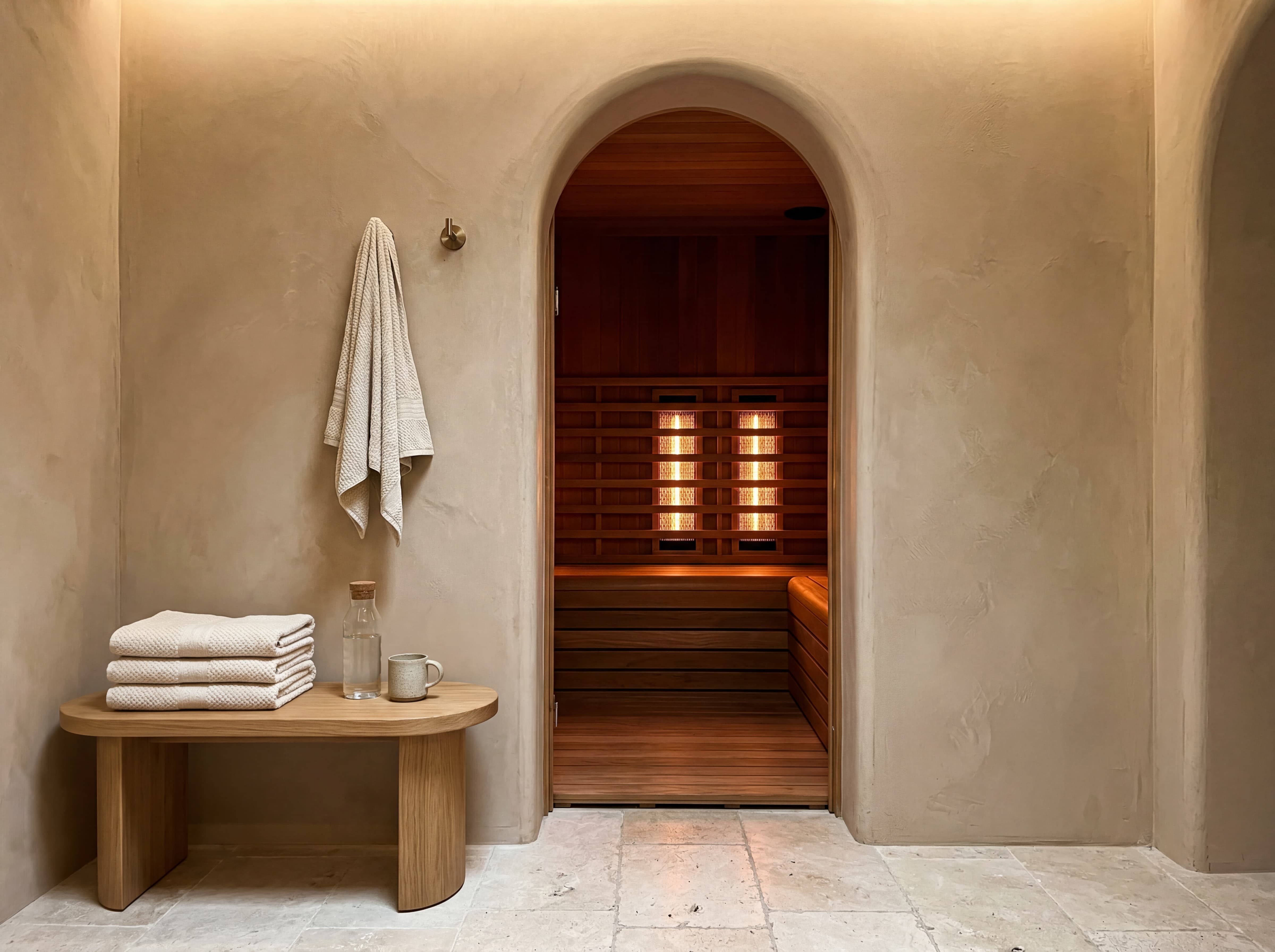
Heat opens you up. Cold gets your full attention. Contrast therapy earns its drama honestly: two very different stresses, one deliciously clear return to neutral. The feeling is immediate for many people. The research on the combined ritual is still catching up.
The useful science starts by refusing to mash everything together. Sauna research includes long-term observational work and smaller controlled trials. Cold-water research often studies the immediate response or athletic recovery. Evidence on alternating the two is smaller and messier. The ritual can still be excellent without every goosebump becoming a clinical endpoint.
First, let it get hot.
A sauna is not subtle. Core temperature and skin blood flow rise, blood vessels dilate, and heart rate climbs. It can feel like light-to-moderate exercise, though it does not replace it. Temperature, time, hydration, and your own physiology still call the shots.
Under the flushed skin, heat also activates heat shock proteins, a family of molecules involved in cellular stress responses. Researchers study this as one possible mechanism. Much of the long-term outcome evidence still comes from observational Finnish cohorts, so it cannot show that sauna alone caused the reported benefits.
Heat opens the door. Cold walks in without knocking.
Then let the cold have your attention.
Cold water is even less polite. Peripheral blood vessels constrict quickly, and the cold-shock response can bring gasping, rapid breathing, and higher heart rate and blood pressure. The first reaction is involuntary and strongest on entry. Trying to force a breathing pattern or hold your breath in the water is not a way to make it safe.
Some people describe feeling unusually clear afterwards. That experience does not mean the initial stress was harmless, and it is not a reason to stay in until breathing feels normal. The afterglow is a personal report, not a reliable sign that a particular exposure suits you.
Together, they have chemistry.
Put them together and blood vessels repeatedly dilate and constrict, a pattern sometimes called vascular training. That name has better marketing than evidence: combined-protocol studies are smaller than the sauna and cold-water literature and do not support sweeping long-term health claims.
The appeal does not need sweeping claims. It is effort, release, and a clean line between the two. The ritual feels vivid. It does not have to pretend to be a cure to be worth wanting.
What contrast will not do for you.
Contrast will not fix your life. It is not meaningful fat loss, and it does not outrank sleep, food, exercise, therapy, or medical care. Anyone promising otherwise is selling fantasy in a very cold tub.
What it can offer is a slow, vivid hour and a hard reset in the everyday sense, not the medical one. Not magic. Still worth building a house around.
Notes & citations
- RNLI and Professor Mike Tipton, Coastal & Waterside Saunas: Minimising Risk (2025)
- American Heart Association: Getting Active to Control High Blood Pressure (accessed 2026-10-20)
- Laukkanen T et al., Cardiovascular and Other Health Benefits of Sauna Bathing, Mayo Clinic Proceedings (2018)
- Tipton MJ et al., Cold water immersion: kill or cure? Experimental Physiology (2017)
- Versey NG et al., Water Immersion Recovery for Athletes, Sports Medicine (2013)
Article details
- Published
- Updated