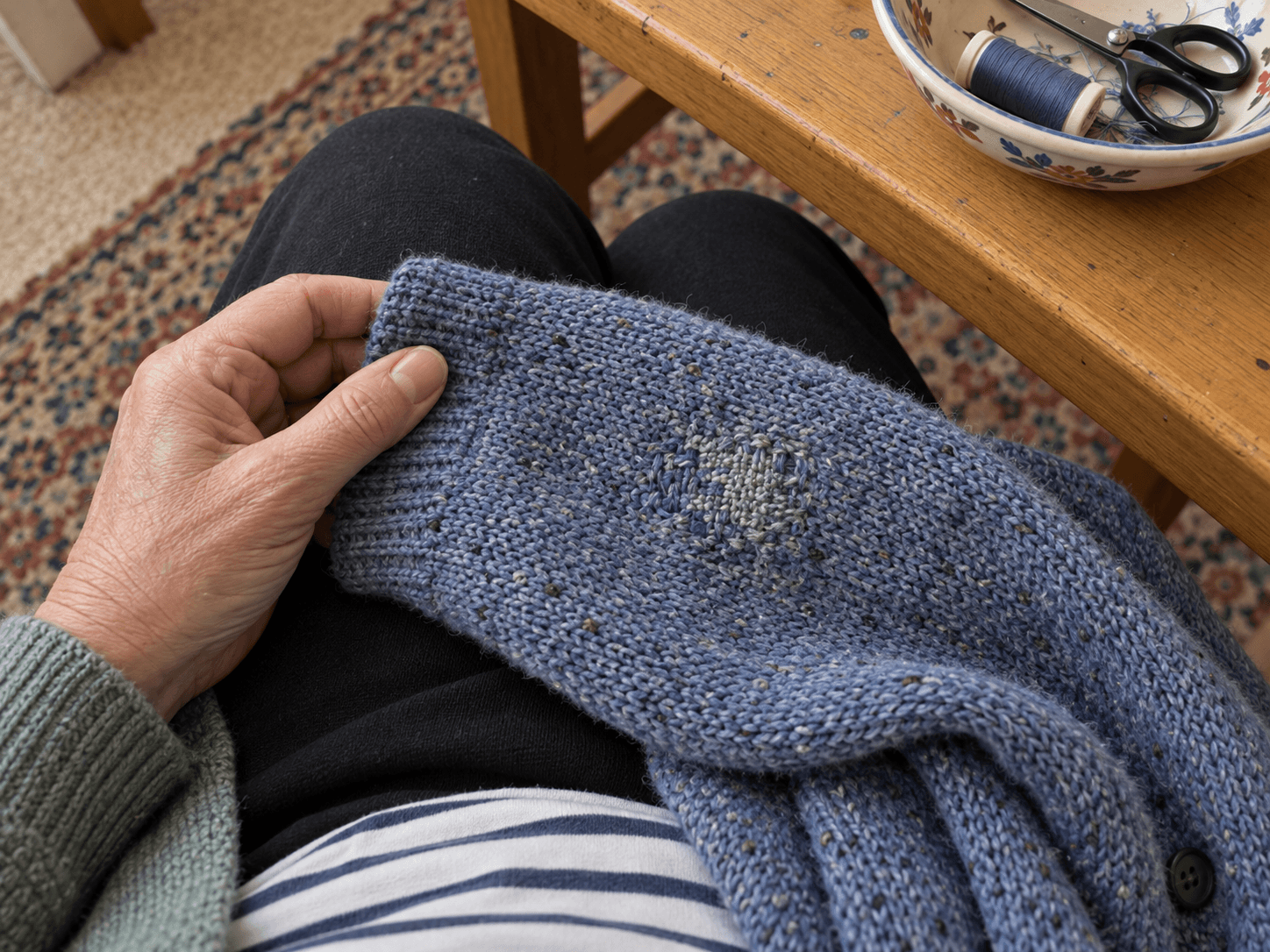
Dev asked what we were going to do. "I am going to mend this," I said, holding up a cardigan with a thumb-sized hole in the sleeve. "You could bring your book." He studied the hole. "Have you considered buying a cardigan that already has sleeves?"
I had been cancelling social plans because I did not want to go anywhere, then complaining that I had not seen anyone. Dev, who had listened to both halves of this argument, suggested I might be able to solve one of them.
The invitation felt suspiciously small. No lunch, no tickets, no destination. Just a couple of hours at mine with something each of us wanted to do. I added that we did not need to talk the whole time. He replied, "I was hoping to find out who did it."
We had different versions of quiet.
He arrived with the book and a container of grapes, which I accepted as an upgrade to my plan. I put the radio on. He sat down, opened the book, read the same page for a while and asked whether I minded turning it off.
I had meant quiet as in nobody needed entertaining. He had meant quiet as in he could follow a sentence. Neither definition was unreasonable. They were simply not the same definition.
We turned it off. I asked whether occasional talking was all right. "Yes," he said, "but if I hold up one finger, let me finish the paragraph." I asked if he was planning to use the finger as a general review of my conversation. He said he was reserving that option.
We also established that he needed to leave at four. I had a tendency to interpret somebody putting on shoes as the beginning of a negotiation. Knowing the time in advance seemed kinder to both of us.
I kept trying to be a host.
For the first ten minutes I offered things. Tea. A cushion. A different chair. The grapes he had himself brought. He eventually said, without looking up, "Harriet, I am extremely well supplied."
I sat at the table and threaded the needle. There was enough room for my sewing things without taking over his chair or the path to the kitchen. I put the little scissors in a dish rather than leaving them under the cardigan, where I would inevitably forget them.
Then we did the things we had said we would do. The room was not silent: a bus passed, the fridge clicked, Dev turned pages with the determination of someone being misled by a detective. I could hear another person nearby without being responsible for the next sentence.
Occasionally I showed him the sleeve. Occasionally he made an annoyed noise at the book. Neither of us had to convert these events into a discussion. When he did want to explain the plot, I put the needle down so I could listen properly.
We did eventually talk.
At half past three, he closed the book and asked about my sister. I told him what had been happening. It was a longer answer than I had expected to give. The afternoon had not been arranged as a serious conversation, but there was room for one.
He did not claim that reading in the same room had fixed anything. He listened, asked a sensible question and helped me find the needle I had just put down. This was a useful range of services.
At four he left. The cardigan was wearable and the detective had apparently arrested the wrong person. We agreed to do it again, with the explicit understanding that next time one of us might want to go for lunch instead.
I did not want every visit to become two people studiously avoiding eye contact. I just wanted this kind of afternoon to be available. There are days when I have plenty to say. There are also days when I would like someone to sit nearby while I make a rather uneven attempt at a sleeve.
Story details
First-person account ·